
Zahid Al Muhasibi
Digital Product Research & Design

Research
Mobile
Desktop
Making Health Data Feel Motivating
Designing feedback systems that encourage consistency, progress awareness, and long-term healthy behavior.
Designing feedback systems that encourage consistency, progress awareness, and long-term healthy behavior.
View Prototype
01 Context & Challenge
Context
Health problems rarely fail because people don’t care. They fail because the benefits of healthy behavior are delayed, while the effort is immediate.
Most users already know what they should do — walk more, sleep better, eat mindfully. The real challenge is showing up every day, especially when there is no urgency, no pain, and no visible consequence yet.
In this state, health data alone has low emotional weight. Numbers exist, progress exists, but motivation quietly fades.
This creates a critical opportunity for the product:
Not to educate users more, but to keep health present in their daily attention.
The Problem
The core problem is not a lack of health information. Most users already understand what healthy behavior looks like.
The challenge is maintaining motivation when the benefits of those behaviors feel distant, while the effort is immediate.
As a result:
Daily actions feel repetitive and easy to postpone
Progress is difficult to notice in the short term
Motivation gradually declines despite good intentions
Users rarely abandon health goals because they make a conscious decision to quit. More often, they disengage because today's effort feels disconnected from visible progress.
Design Lens
This case approaches health tracking through a behavioral motivation lens rather than a data-first one.
One of the biggest challenges in health products is that outcomes are delayed while effort is immediate. Users may take healthy actions today, but the benefits often remain invisible for weeks or months.
“The most effective rewards are those that reinforce the behavior itself.” — B.J. Fogg, Behavior Design
In health products, users rarely experience immediate results from a single action. What they can experience immediately is progress. This perspective informed the use of challenges, feedback loops, and rewards as tools to make effort feel meaningful before health outcomes become visible.
01 Context & Challenge
Context
Health problems rarely fail because people don’t care. They fail because the benefits of healthy behavior are delayed, while the effort is immediate.
Most users already know what they should do — walk more, sleep better, eat mindfully. The real challenge is showing up every day, especially when there is no urgency, no pain, and no visible consequence yet.
In this state, health data alone has low emotional weight. Numbers exist, progress exists, but motivation quietly fades.
This creates a critical opportunity for the product:
Not to educate users more, but to keep health present in their daily attention.
The Problem
The core problem is not a lack of health information. Most users already understand what healthy behavior looks like.
The challenge is maintaining motivation when the benefits of those behaviors feel distant, while the effort is immediate.
As a result:
Daily actions feel repetitive and easy to postpone
Progress is difficult to notice in the short term
Motivation gradually declines despite good intentions
Users rarely abandon health goals because they make a conscious decision to quit. More often, they disengage because today's effort feels disconnected from visible progress.
Design Lens
This case approaches health tracking through a behavioral motivation lens rather than a data-first one.
One of the biggest challenges in health products is that outcomes are delayed while effort is immediate. Users may take healthy actions today, but the benefits often remain invisible for weeks or months.
“The most effective rewards are those that reinforce the behavior itself.” — B.J. Fogg, Behavior Design
In health products, users rarely experience immediate results from a single action. What they can experience immediately is progress. This perspective informed the use of challenges, feedback loops, and rewards as tools to make effort feel meaningful before health outcomes become visible.
01 Context & Challenge
Context
Health problems rarely fail because people don’t care. They fail because the benefits of healthy behavior are delayed, while the effort is immediate.
Most users already know what they should do — walk more, sleep better, eat mindfully. The real challenge is showing up every day, especially when there is no urgency, no pain, and no visible consequence yet.
In this state, health data alone has low emotional weight. Numbers exist, progress exists, but motivation quietly fades.
This creates a critical opportunity for the product:
Not to educate users more, but to keep health present in their daily attention.
The Problem
The core problem is not a lack of health information. Most users already understand what healthy behavior looks like.
The challenge is maintaining motivation when the benefits of those behaviors feel distant, while the effort is immediate.
As a result:
Daily actions feel repetitive and easy to postpone
Progress is difficult to notice in the short term
Motivation gradually declines despite good intentions
Users rarely abandon health goals because they make a conscious decision to quit. More often, they disengage because today's effort feels disconnected from visible progress.
Design Lens
This case approaches health tracking through a behavioral motivation lens rather than a data-first one.
One of the biggest challenges in health products is that outcomes are delayed while effort is immediate. Users may take healthy actions today, but the benefits often remain invisible for weeks or months.
“The most effective rewards are those that reinforce the behavior itself.” — B.J. Fogg, Behavior Design
In health products, users rarely experience immediate results from a single action. What they can experience immediately is progress. This perspective informed the use of challenges, feedback loops, and rewards as tools to make effort feel meaningful before health outcomes become visible.
01 Context & Challenge
Context
Health problems rarely fail because people don’t care. They fail because the benefits of healthy behavior are delayed, while the effort is immediate.
Most users already know what they should do — walk more, sleep better, eat mindfully. The real challenge is showing up every day, especially when there is no urgency, no pain, and no visible consequence yet.
In this state, health data alone has low emotional weight. Numbers exist, progress exists, but motivation quietly fades.
This creates a critical opportunity for the product:
Not to educate users more, but to keep health present in their daily attention.
The Problem
The core problem is not a lack of health information. Most users already understand what healthy behavior looks like.
The challenge is maintaining motivation when the benefits of those behaviors feel distant, while the effort is immediate.
As a result:
Daily actions feel repetitive and easy to postpone
Progress is difficult to notice in the short term
Motivation gradually declines despite good intentions
Users rarely abandon health goals because they make a conscious decision to quit. More often, they disengage because today's effort feels disconnected from visible progress.
Design Lens
This case approaches health tracking through a behavioral motivation lens rather than a data-first one.
One of the biggest challenges in health products is that outcomes are delayed while effort is immediate. Users may take healthy actions today, but the benefits often remain invisible for weeks or months.
“The most effective rewards are those that reinforce the behavior itself.” — B.J. Fogg, Behavior Design
In health products, users rarely experience immediate results from a single action. What they can experience immediately is progress. This perspective informed the use of challenges, feedback loops, and rewards as tools to make effort feel meaningful before health outcomes become visible.
02 Problem Framing & Analysis
Key Insight
Users rarely stop engaging with health products because they lack information.
They stop because they lose evidence that their effort matters.
Across observed engagement patterns, motivation declined not when users failed to achieve goals, but when daily actions stopped producing visible signs of progress.
When progress feels invisible, healthy behavior becomes harder to justify. As a result, users gradually disengage long before any health outcome changes.
“People need to experience competence, autonomy, and relatedness in order to sustain motivation.”
— Edward Deci & Richard Ryan, Self-Determination Theory
In health products, competence often comes from visible progress rather than health outcomes themselves. Users may not immediately feel healthier after a walk, completing a challenge, or answering a quiz correctly, but they can feel progress. Designing for motivation means making that progress visible before results become noticeable.
Data & Process Behind the Insight
This insight emerged through a review of behavioral psychology principles, habit-formation frameworks, and common engagement patterns found in health and wellness products.
The exploration focused on understanding why users gradually disengage from health tracking experiences despite having access to sufficient information and clear goals.
Health outcomes are often delayed, making daily effort difficult to connect with meaningful results.
Users are more likely to sustain behavior when progress is visible and feedback is immediate.
Engagement tends to decline when actions feel repetitive, unrewarded, or disconnected from a sense of achievement.
These observations informed the design direction explored in the following section: using challenges, visible progress, and lightweight rewards to create shorter and more motivating feedback loops.
Why This Matters?
Most health and wellness products struggle at this exact point:
Users continue normal behavior until engagement drops without a clear “failure moment”
Progress feels abstract, making effort easy to postpone or skip
When motivation dips, there’s no system response to pull users back in
From a behavioral perspective:
Users need short feedback loops, not long-term promises
Recognition of effort matters more than outcome in early-stage habit formation
Inaction should feel noticeable, while action should feel rewarded
Without this, even well-designed health dashboards become passive tools instead of active behavior drivers.
02 Problem Framing & Analysis
Key Insight
Users rarely stop engaging with health products because they lack information.
They stop because they lose evidence that their effort matters.
Across observed engagement patterns, motivation declined not when users failed to achieve goals, but when daily actions stopped producing visible signs of progress.
When progress feels invisible, healthy behavior becomes harder to justify. As a result, users gradually disengage long before any health outcome changes.
“People need to experience competence, autonomy, and relatedness in order to sustain motivation.”
— Edward Deci & Richard Ryan, Self-Determination Theory
In health products, competence often comes from visible progress rather than health outcomes themselves. Users may not immediately feel healthier after a walk, completing a challenge, or answering a quiz correctly, but they can feel progress. Designing for motivation means making that progress visible before results become noticeable.
Data & Process Behind the Insight
This insight emerged through a review of behavioral psychology principles, habit-formation frameworks, and common engagement patterns found in health and wellness products.
The exploration focused on understanding why users gradually disengage from health tracking experiences despite having access to sufficient information and clear goals.
Health outcomes are often delayed, making daily effort difficult to connect with meaningful results.
Users are more likely to sustain behavior when progress is visible and feedback is immediate.
Engagement tends to decline when actions feel repetitive, unrewarded, or disconnected from a sense of achievement.
These observations informed the design direction explored in the following section: using challenges, visible progress, and lightweight rewards to create shorter and more motivating feedback loops.
Why This Matters?
Most health and wellness products struggle at this exact point:
Users continue normal behavior until engagement drops without a clear “failure moment”
Progress feels abstract, making effort easy to postpone or skip
When motivation dips, there’s no system response to pull users back in
From a behavioral perspective:
Users need short feedback loops, not long-term promises
Recognition of effort matters more than outcome in early-stage habit formation
Inaction should feel noticeable, while action should feel rewarded
Without this, even well-designed health dashboards become passive tools instead of active behavior drivers.
02 Problem Framing & Analysis
Key Insight
Users rarely stop engaging with health products because they lack information.
They stop because they lose evidence that their effort matters.
Across observed engagement patterns, motivation declined not when users failed to achieve goals, but when daily actions stopped producing visible signs of progress.
When progress feels invisible, healthy behavior becomes harder to justify. As a result, users gradually disengage long before any health outcome changes.
“People need to experience competence, autonomy, and relatedness in order to sustain motivation.”
— Edward Deci & Richard Ryan, Self-Determination Theory
In health products, competence often comes from visible progress rather than health outcomes themselves. Users may not immediately feel healthier after a walk, completing a challenge, or answering a quiz correctly, but they can feel progress. Designing for motivation means making that progress visible before results become noticeable.
Data & Process Behind the Insight
This insight emerged through a review of behavioral psychology principles, habit-formation frameworks, and common engagement patterns found in health and wellness products.
The exploration focused on understanding why users gradually disengage from health tracking experiences despite having access to sufficient information and clear goals.
Health outcomes are often delayed, making daily effort difficult to connect with meaningful results.
Users are more likely to sustain behavior when progress is visible and feedback is immediate.
Engagement tends to decline when actions feel repetitive, unrewarded, or disconnected from a sense of achievement.
These observations informed the design direction explored in the following section: using challenges, visible progress, and lightweight rewards to create shorter and more motivating feedback loops.
Why This Matters?
Most health and wellness products struggle at this exact point:
Users continue normal behavior until engagement drops without a clear “failure moment”
Progress feels abstract, making effort easy to postpone or skip
When motivation dips, there’s no system response to pull users back in
From a behavioral perspective:
Users need short feedback loops, not long-term promises
Recognition of effort matters more than outcome in early-stage habit formation
Inaction should feel noticeable, while action should feel rewarded
Without this, even well-designed health dashboards become passive tools instead of active behavior drivers.
02 Problem Framing & Analysis
03 Executing the Vision
Design Implementation
This section demonstrates how behavioral insights were translated into design decisions that strengthen motivation through short feedback loops, visible progress, and positive reinforcement.
Rather than relying on long-term health outcomes, the experience focuses on making daily effort feel meaningful today, increasing the likelihood that users return tomorrow.
Case 1: Making Progress Visible Before Results Appear
One of the biggest challenges in health products is sustaining daily engagement. Most users already understand what healthy behavior looks like. The challenge is rarely knowledge; it is maintaining momentum when progress feels slow and rewards feel distant.
In this case, the focus was not on educating users further, but on making daily actions feel visible, measurable, and rewarding.
Challenge & Design Response:
Sustaining daily engagement is a core challenge in health products. While users generally understand what actions to take, they often disengage when progress feels invisible, repetitive, or too far removed from tangible rewards.
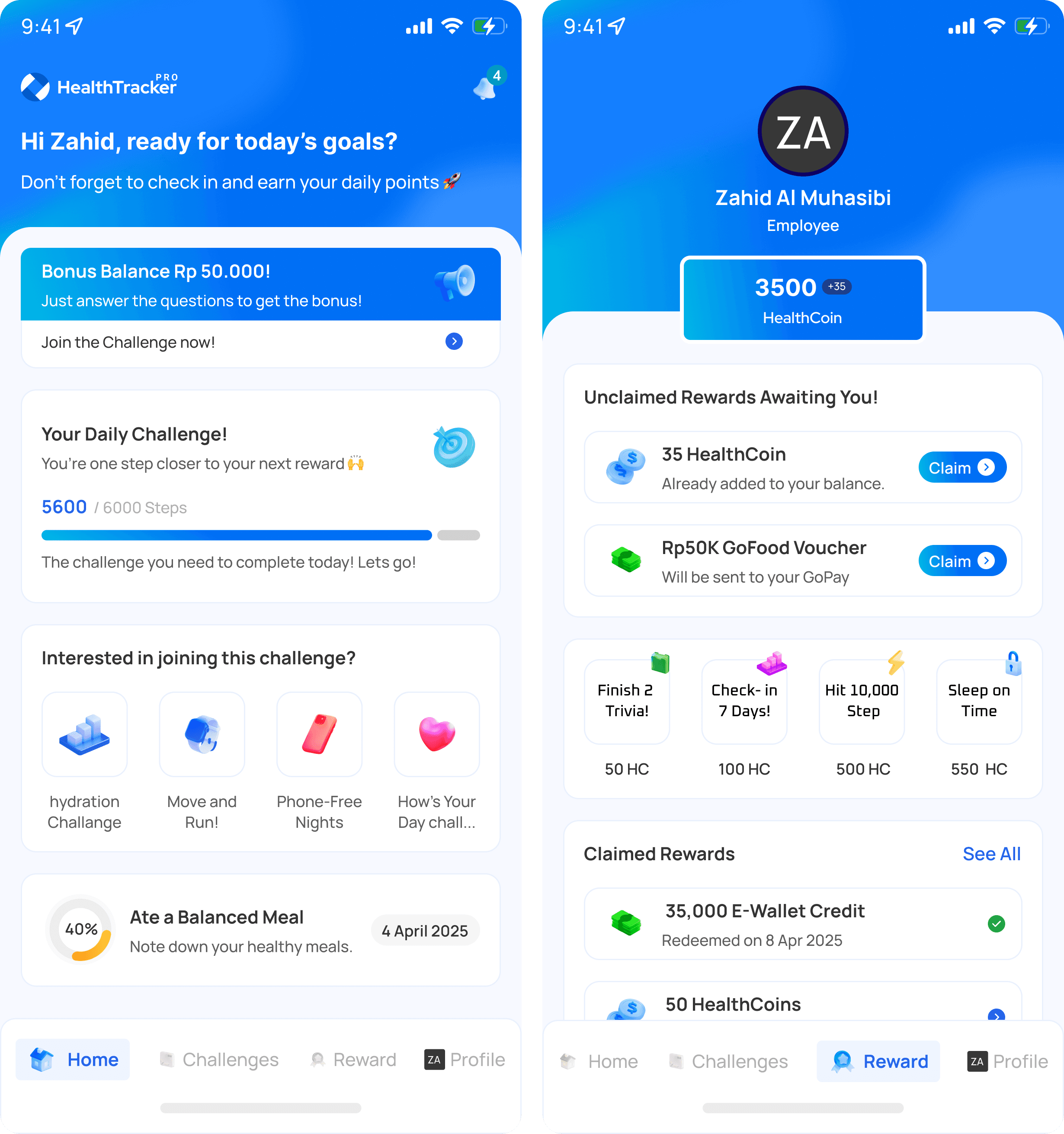
To address this, the design surfaces Daily Challenges directly on the home screen, paired with:
Clear daily targets
Visual progress indicators
Instant rewards upon completion
This shortens the feedback loop between action and outcome, turning routine health tracking into a simple, goal-oriented daily experience.
Implementation Decisions:
Progress as Motivation
The progress bar (e.g. 5600 / 6000 steps) turns abstract health behavior into a clear, finishable task. Users don’t think in terms of “being healthier,” but in terms of “I’m almost there.”Rewards Before Fatigue
Instead of waiting for weekly or monthly milestones, rewards are surfaced immediately after completion — reinforcing behavior while motivation is still high.Low Cognitive Load
Challenges are framed as simple, achievable goals. No dashboards, no complex metrics, just what to do today and how close you are.
Design Rationale
The design focuses on reinforcing competence through visible progress and immediate recognition.
Rather than asking users to stay motivated by distant health outcomes, the experience creates small moments of success that users can achieve every day.
Key considerations:
Progress should feel visible before health outcomes become noticeable
Goals should feel achievable enough to encourage consistency
Recognition should happen close to the action that created it
By shortening the distance between effort and recognition, the design helps users experience progress before they experience results. This makes healthy actions feel worthwhile in the present, increasing the likelihood that they become repeatable habits over time.
Case 2: Reinforcing Health Awareness Through Micro-Learning
Health education is often treated as a separate activity from health tracking.
Users may understand that learning about nutrition, exercise, or healthy habits is beneficial, but educational content frequently competes with other priorities for attention. As a result, articles are skipped, reminders are ignored, and learning becomes an occasional activity rather than a consistent behavior.
The challenge was not making information available, but making engagement with that information feel worth repeating.
Challenge & Design Response:
Traditional educational content often requires a high level of attention and commitment, creating friction for users who simply want quick, actionable insights.
To encourage more consistent participation, the experience reframes health learning as a lightweight daily activity through:
Short interactive quizzes
Immediate feedback
Visible rewards and achievements
Rather than asking users to consume large amounts of information, the design focuses on creating small moments of engagement that can be repeated frequently.
Implementation Decisions:
Timed Micro-Quiz Interaction
Health education is delivered through short quizzes designed to be completed within seconds rather than minutes. A countdown timer introduces a sense of momentum and engagement, helping the experience feel active rather than instructional.Immediate Reward & Feedback System
Upon completion, users receive HealthCoins, vouchers, and performance feedback. The reward is intentionally delivered at the moment of participation, reinforcing the behavior while motivation is still present.Social Comparison & Achievement Signals
Leaderboards, rankings, and achievement badges provide additional feedback beyond correctness alone.
These elements help users track improvement over time while creating a sense of progression and accomplishment.

Design Rationale
The objective is not to make learning feel like a game.
The objective is to make health awareness easier to revisit consistently.
Key considerations:
Educational content should feel approachable enough to engage with daily
Feedback should reinforce participation immediately
Progress should remain visible beyond a single interaction
By reducing the effort required to engage and increasing the visibility of achievement, the experience transforms health education from passive content consumption into a repeatable habit.
This supports long-term awareness while maintaining a lightweight and enjoyable experience.
03 Executing the Vision
Design Implementation
This section demonstrates how behavioral insights were translated into design decisions that strengthen motivation through short feedback loops, visible progress, and positive reinforcement.
Rather than relying on long-term health outcomes, the experience focuses on making daily effort feel meaningful today, increasing the likelihood that users return tomorrow.
Case 1: Making Progress Visible Before Results Appear
One of the biggest challenges in health products is sustaining daily engagement. Most users already understand what healthy behavior looks like. The challenge is rarely knowledge; it is maintaining momentum when progress feels slow and rewards feel distant.
In this case, the focus was not on educating users further, but on making daily actions feel visible, measurable, and rewarding.
Challenge & Design Response:
Sustaining daily engagement is a core challenge in health products. While users generally understand what actions to take, they often disengage when progress feels invisible, repetitive, or too far removed from tangible rewards.
To address this, the design surfaces Daily Challenges directly on the home screen, paired with:
Clear daily targets
Visual progress indicators
Instant rewards upon completion
This shortens the feedback loop between action and outcome, turning routine health tracking into a simple, goal-oriented daily experience.
Implementation Decisions:
Progress as Motivation
The progress bar (e.g. 5600 / 6000 steps) turns abstract health behavior into a clear, finishable task. Users don’t think in terms of “being healthier,” but in terms of “I’m almost there.”Rewards Before Fatigue
Instead of waiting for weekly or monthly milestones, rewards are surfaced immediately after completion — reinforcing behavior while motivation is still high.Low Cognitive Load
Challenges are framed as simple, achievable goals. No dashboards, no complex metrics, just what to do today and how close you are.
Design Rationale
The design focuses on reinforcing competence through visible progress and immediate recognition.
Rather than asking users to stay motivated by distant health outcomes, the experience creates small moments of success that users can achieve every day.
Key considerations:
Progress should feel visible before health outcomes become noticeable
Goals should feel achievable enough to encourage consistency
Recognition should happen close to the action that created it
By shortening the distance between effort and recognition, the design helps users experience progress before they experience results. This makes healthy actions feel worthwhile in the present, increasing the likelihood that they become repeatable habits over time.
Case 2: Reinforcing Health Awareness Through Micro-Learning
Health education is often treated as a separate activity from health tracking.
Users may understand that learning about nutrition, exercise, or healthy habits is beneficial, but educational content frequently competes with other priorities for attention. As a result, articles are skipped, reminders are ignored, and learning becomes an occasional activity rather than a consistent behavior.
The challenge was not making information available, but making engagement with that information feel worth repeating.
Challenge & Design Response:
Traditional educational content often requires a high level of attention and commitment, creating friction for users who simply want quick, actionable insights.
To encourage more consistent participation, the experience reframes health learning as a lightweight daily activity through:
Short interactive quizzes
Immediate feedback
Visible rewards and achievements
Rather than asking users to consume large amounts of information, the design focuses on creating small moments of engagement that can be repeated frequently.
Implementation Decisions:
Timed Micro-Quiz Interaction
Health education is delivered through short quizzes designed to be completed within seconds rather than minutes. A countdown timer introduces a sense of momentum and engagement, helping the experience feel active rather than instructional.Immediate Reward & Feedback System
Upon completion, users receive HealthCoins, vouchers, and performance feedback. The reward is intentionally delivered at the moment of participation, reinforcing the behavior while motivation is still present.Social Comparison & Achievement Signals
Leaderboards, rankings, and achievement badges provide additional feedback beyond correctness alone.
These elements help users track improvement over time while creating a sense of progression and accomplishment.
Design Rationale
The objective is not to make learning feel like a game.
The objective is to make health awareness easier to revisit consistently.
Key considerations:
Educational content should feel approachable enough to engage with daily
Feedback should reinforce participation immediately
Progress should remain visible beyond a single interaction
By reducing the effort required to engage and increasing the visibility of achievement, the experience transforms health education from passive content consumption into a repeatable habit.
This supports long-term awareness while maintaining a lightweight and enjoyable experience.
03 Executing the Vision
Design Implementation
This section demonstrates how behavioral insights were translated into design decisions that strengthen motivation through short feedback loops, visible progress, and positive reinforcement.
Rather than relying on long-term health outcomes, the experience focuses on making daily effort feel meaningful today, increasing the likelihood that users return tomorrow.
Case 1: Making Progress Visible Before Results Appear
One of the biggest challenges in health products is sustaining daily engagement. Most users already understand what healthy behavior looks like. The challenge is rarely knowledge; it is maintaining momentum when progress feels slow and rewards feel distant.
In this case, the focus was not on educating users further, but on making daily actions feel visible, measurable, and rewarding.
Challenge & Design Response:
Sustaining daily engagement is a core challenge in health products. While users generally understand what actions to take, they often disengage when progress feels invisible, repetitive, or too far removed from tangible rewards.
To address this, the design surfaces Daily Challenges directly on the home screen, paired with:
Clear daily targets
Visual progress indicators
Instant rewards upon completion
This shortens the feedback loop between action and outcome, turning routine health tracking into a simple, goal-oriented daily experience.
Implementation Decisions:
Progress as Motivation
The progress bar (e.g. 5600 / 6000 steps) turns abstract health behavior into a clear, finishable task. Users don’t think in terms of “being healthier,” but in terms of “I’m almost there.”Rewards Before Fatigue
Instead of waiting for weekly or monthly milestones, rewards are surfaced immediately after completion — reinforcing behavior while motivation is still high.Low Cognitive Load
Challenges are framed as simple, achievable goals. No dashboards, no complex metrics, just what to do today and how close you are.
Design Rationale
The design focuses on reinforcing competence through visible progress and immediate recognition.
Rather than asking users to stay motivated by distant health outcomes, the experience creates small moments of success that users can achieve every day.
Key considerations:
Progress should feel visible before health outcomes become noticeable
Goals should feel achievable enough to encourage consistency
Recognition should happen close to the action that created it
By shortening the distance between effort and recognition, the design helps users experience progress before they experience results. This makes healthy actions feel worthwhile in the present, increasing the likelihood that they become repeatable habits over time.
Case 2: Reinforcing Health Awareness Through Micro-Learning
Health education is often treated as a separate activity from health tracking.
Users may understand that learning about nutrition, exercise, or healthy habits is beneficial, but educational content frequently competes with other priorities for attention. As a result, articles are skipped, reminders are ignored, and learning becomes an occasional activity rather than a consistent behavior.
The challenge was not making information available, but making engagement with that information feel worth repeating.
Challenge & Design Response:
Traditional educational content often requires a high level of attention and commitment, creating friction for users who simply want quick, actionable insights.
To encourage more consistent participation, the experience reframes health learning as a lightweight daily activity through:
Short interactive quizzes
Immediate feedback
Visible rewards and achievements
Rather than asking users to consume large amounts of information, the design focuses on creating small moments of engagement that can be repeated frequently.
Implementation Decisions:
Timed Micro-Quiz Interaction
Health education is delivered through short quizzes designed to be completed within seconds rather than minutes. A countdown timer introduces a sense of momentum and engagement, helping the experience feel active rather than instructional.Immediate Reward & Feedback System
Upon completion, users receive HealthCoins, vouchers, and performance feedback. The reward is intentionally delivered at the moment of participation, reinforcing the behavior while motivation is still present.Social Comparison & Achievement Signals
Leaderboards, rankings, and achievement badges provide additional feedback beyond correctness alone.
These elements help users track improvement over time while creating a sense of progression and accomplishment.
Design Rationale
The objective is not to make learning feel like a game.
The objective is to make health awareness easier to revisit consistently.
Key considerations:
Educational content should feel approachable enough to engage with daily
Feedback should reinforce participation immediately
Progress should remain visible beyond a single interaction
By reducing the effort required to engage and increasing the visibility of achievement, the experience transforms health education from passive content consumption into a repeatable habit.
This supports long-term awareness while maintaining a lightweight and enjoyable experience.
03 Executing the Vision
Design Implementation
This section demonstrates how behavioral insights were translated into design decisions that strengthen motivation through short feedback loops, visible progress, and positive reinforcement.
Rather than relying on long-term health outcomes, the experience focuses on making daily effort feel meaningful today, increasing the likelihood that users return tomorrow.
Case 1: Making Progress Visible Before Results Appear
One of the biggest challenges in health products is sustaining daily engagement. Most users already understand what healthy behavior looks like. The challenge is rarely knowledge; it is maintaining momentum when progress feels slow and rewards feel distant.
In this case, the focus was not on educating users further, but on making daily actions feel visible, measurable, and rewarding.
Challenge & Design Response:
Sustaining daily engagement is a core challenge in health products. While users generally understand what actions to take, they often disengage when progress feels invisible, repetitive, or too far removed from tangible rewards.
To address this, the design surfaces Daily Challenges directly on the home screen, paired with:
Clear daily targets
Visual progress indicators
Instant rewards upon completion
This shortens the feedback loop between action and outcome, turning routine health tracking into a simple, goal-oriented daily experience.
Implementation Decisions:
Progress as Motivation
The progress bar (e.g. 5600 / 6000 steps) turns abstract health behavior into a clear, finishable task. Users don’t think in terms of “being healthier,” but in terms of “I’m almost there.”Rewards Before Fatigue
Instead of waiting for weekly or monthly milestones, rewards are surfaced immediately after completion — reinforcing behavior while motivation is still high.Low Cognitive Load
Challenges are framed as simple, achievable goals. No dashboards, no complex metrics, just what to do today and how close you are.
Design Rationale
The design focuses on reinforcing competence through visible progress and immediate recognition.
Rather than asking users to stay motivated by distant health outcomes, the experience creates small moments of success that users can achieve every day.
Key considerations:
Progress should feel visible before health outcomes become noticeable
Goals should feel achievable enough to encourage consistency
Recognition should happen close to the action that created it
By shortening the distance between effort and recognition, the design helps users experience progress before they experience results. This makes healthy actions feel worthwhile in the present, increasing the likelihood that they become repeatable habits over time.
Case 2: Reinforcing Health Awareness Through Micro-Learning
Health education is often treated as a separate activity from health tracking.
Users may understand that learning about nutrition, exercise, or healthy habits is beneficial, but educational content frequently competes with other priorities for attention. As a result, articles are skipped, reminders are ignored, and learning becomes an occasional activity rather than a consistent behavior.
The challenge was not making information available, but making engagement with that information feel worth repeating.
Challenge & Design Response:
Traditional educational content often requires a high level of attention and commitment, creating friction for users who simply want quick, actionable insights.
To encourage more consistent participation, the experience reframes health learning as a lightweight daily activity through:
Short interactive quizzes
Immediate feedback
Visible rewards and achievements
Rather than asking users to consume large amounts of information, the design focuses on creating small moments of engagement that can be repeated frequently.
Implementation Decisions:
Timed Micro-Quiz Interaction
Health education is delivered through short quizzes designed to be completed within seconds rather than minutes. A countdown timer introduces a sense of momentum and engagement, helping the experience feel active rather than instructional.Immediate Reward & Feedback System
Upon completion, users receive HealthCoins, vouchers, and performance feedback. The reward is intentionally delivered at the moment of participation, reinforcing the behavior while motivation is still present.Social Comparison & Achievement Signals
Leaderboards, rankings, and achievement badges provide additional feedback beyond correctness alone.
These elements help users track improvement over time while creating a sense of progression and accomplishment.
Design Rationale
The objective is not to make learning feel like a game.
The objective is to make health awareness easier to revisit consistently.
Key considerations:
Educational content should feel approachable enough to engage with daily
Feedback should reinforce participation immediately
Progress should remain visible beyond a single interaction
By reducing the effort required to engage and increasing the visibility of achievement, the experience transforms health education from passive content consumption into a repeatable habit.
This supports long-term awareness while maintaining a lightweight and enjoyable experience.